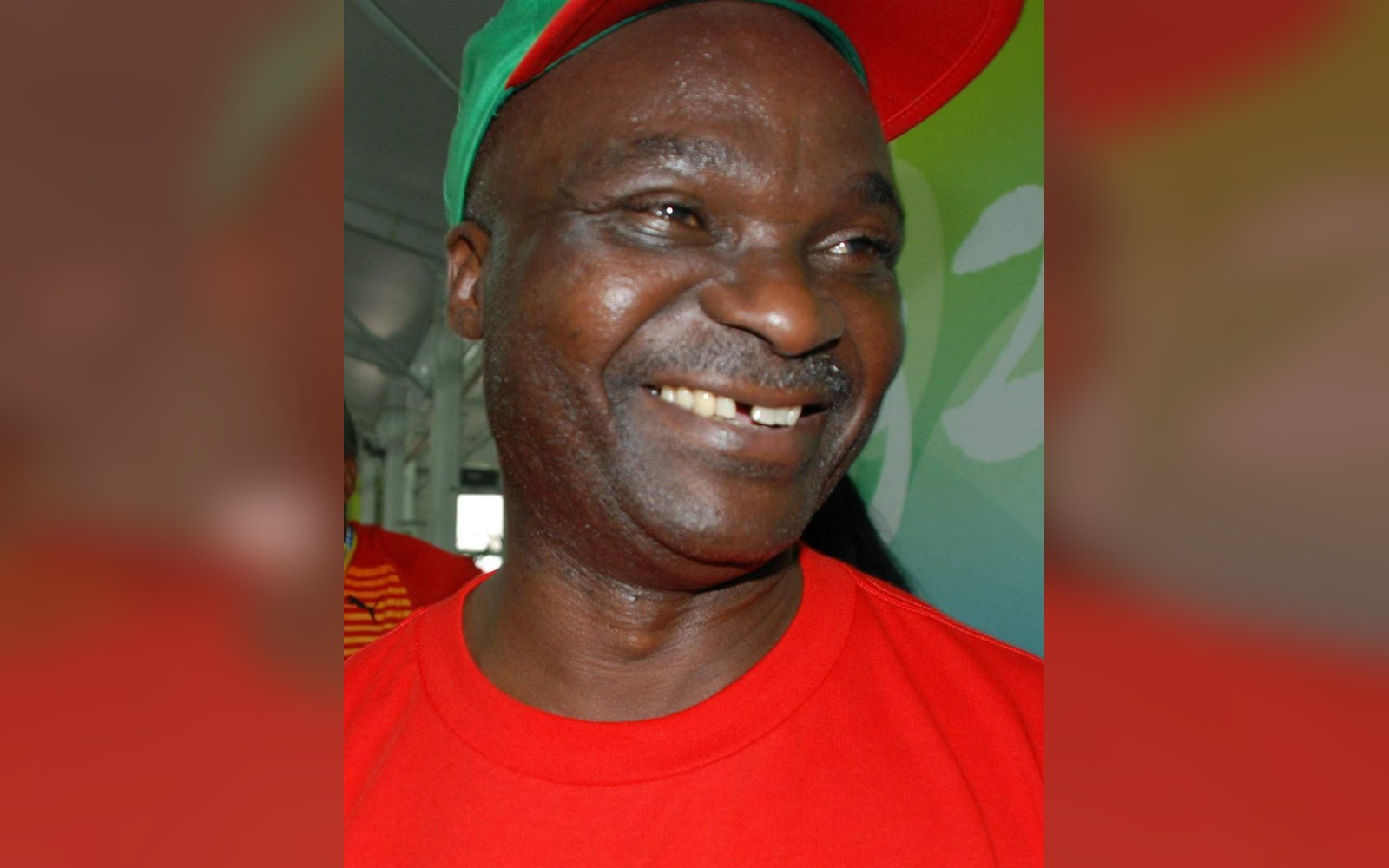
01 · NightsThe recall that changed what was possible
By the time the 1990 World Cup in Italy arrived, Roger Milla had already wound down what most people assumed was his career. He had spent years in French football — Valenciennes, Monaco, Saint-Étienne, Montpellier among the clubs — and had won the African Player of the Year award twice, in 1976 and 1990. He was playing for JS Saint-Pierroise in Réunion, a small island club in the Indian Ocean, which is as far from a World Cup squad as it sounds. The call that changed things came not from a coach but from Paul Biya, the president of Cameroon, who personally intervened to have Milla included in the squad. He was thirty-eight years old, possibly thirty-nine — his precise birth date has been disputed — and he was going to Italia '90 as a substitute.
This was not the conventional route back into international football. Cameroon's campaign had already done the unthinkable before Milla had scored a single minute: the Indomitable Lions opened the tournament against Argentina, the defending champions, and won. That result alone rearranged the assumptions of everyone watching. What followed — Milla coming off the bench, dancing at the corner flag, scoring four goals across the group stage and the round of sixteen — completed something larger. It made the tournament his.
The corner-flag dance was not planned. It arrived instinctively after each goal, a shimmy and a spin that had no precedent in World Cup celebrations and that television cameras, in 1990, were perfectly positioned to turn into an icon. Milla scored twice against Romania in the group stage, twice against Colombia in the round of sixteen, and each time the same ritual played out. The image — a man apparently too old for the occasion, visibly delighted by his own presence in it — travelled everywhere.
02 · NightsWhat the goals actually required
Strip the celebration away and look at the football. Milla's goals were not tap-ins capitalising on fortunate positioning. Against Colombia in the round of sixteen, his second goal came from an error he forced: he closed down the goalkeeper René Higuita, who was famous for his adventurous distribution and his willingness to dribble far outside his area. Milla dispossessed him and scored into an empty net. The whole sequence demanded pace, anticipation and the nerve to press a goalkeeper who had no business being that far from goal. Higuita's eccentricity is part of the story, but Milla's read of the situation and his willingness to act on it in extra time of a World Cup knockout game are what made it happen.
The goals came from the bench, which matters to the arithmetic. Milla was not a starter. Cameroon's coach, Valeri Nepomnyashchy, was a Soviet tactician who ran a defensive structure and used Milla as an impact substitute — someone to introduce when legs were tiring and space was opening. The relationship between Milla's age and his deployment was not incidental: his body could not sustain ninety minutes at that level, but in thirty or forty minutes he remained devastatingly effective. That compression, the idea that a player's peak contribution could be made in a controlled burst rather than across a full match, was unusual in 1990. It is much more familiar now.
Nobody in the stand at the opening match had come to watch a substitute forward playing his club football on Réunion.
Picture deskCameroon reached the quarter-final, where they lost to England after extra time, two goals to three. Gary Lineker scored twice from the penalty spot. The defeat does not diminish what preceded it; it fixes the limit of the run. Milla did not score in that match, which is worth noting because his legend sometimes swallows the team around him — Benjamin Massing, François Omam-Biyick, the defensive solidity that made the whole campaign possible.
03 · NightsWhy the moment lasted
Four goals in Italy, none from the start of a match.
Picture deskItalia '90 was a tournament watched by enormous global audiences at a point when satellite television was extending football's reach into new markets. The images it produced — Gazza's tears, Schillaci's goals, Milla's celebrations — were distributed with a completeness that earlier tournaments had not achieved. That amplification is part of why Milla became the face of what CAF, the Confederation of African Football, could produce. But the amplification required a subject worth distributing, and the subject was real.
Milla's legacy is different in structure: concentrated, theatrical, improbable in timing.
George Weah would win the Ballon d'Or five years later, in 1995, becoming the only African player to do so, and that award rested partly on a decade of sustained individual excellence. His goals and his age together made an argument — not stated but demonstrated — about what African football was. The argument ran against a set of assumptions, common in European football coverage at the time, that CAF's teams were athletic but technically limited and that their players peaked early and faded. A thirty-eight-year-old coming off the bench to score four goals at a World Cup was a specific and irrefutable counter-evidence.
The quota system through which confederation places at the World Cup are distributed was already a point of contention in 1990, with Africa holding fewer automatic berths than its number of associations or its demonstrated competitive quality arguably warranted. What Cameroon did in Italy — and Senegal would repeat twelve years later, beating France in the opening game — accumulated as the practical case for expansion of African representation. Whether FIFA's allocation decisions have tracked that argument fairly is a separate and still-contested question, but the political weight of 1990 was carried by performances, and Milla's were the most visible of them.
The celebration itself entered the visual language of the game permanently. FIFA's own archive ↗ documents it; commentators still reach for it when they want shorthand for unexpected joy. But what it actually showed — which is easy to forget when an image becomes an icon — was a specific man, in a specific year, proving something that had been assumed settled. He was not supposed to be there. He was certainly not supposed to be the face of the tournament. He was both.