
01 · NightsA bid that split before it resolved
Japan expected to host the 2002 World Cup alone. The bid was strong, the infrastructure credible, and the Japanese Football Association had been building toward this moment since the J.League launched in 1993. Then FIFA, unwilling to arbitrate a prolonged fight between two competing Asian bids, did something it had never done: it awarded the tournament jointly to South Korea and Japan in May 1996, making 2002 the first co-hosted World Cup in the competition's history and the first held in Asia.
The decision satisfied neither association. It also created a set of structural problems that FIFA's regulations had no template for, because the rulebook had always assumed one host.
02 · NightsDividing what cannot be split evenly
The immediate questions were logistical. Which country opened the tournament? Who hosted the final? How would the schedule prevent one host's team from having a systematically easier path? FIFA resolved these question by question, assigning the final to Yokohama and the opening match to Seoul. Ten stadiums were built or substantially rebuilt across each country — twenty venues ↗ in total, an infrastructural commitment that no single previous host had matched in raw number. Each country formed its own organising committee, and those two committees required coordination that a normal host simply delegates internally.
The political backdrop made none of this easier. South Korea and Japan carried a history of colonial grievance, and diplomatic relations, while normalised since 1965, remained periodically tense. Football bureaucrats from both countries spent much of the preceding six years negotiating questions that had obvious answers when there was only one host: whose logo led, whose timezone the broadcast windows served, which language appeared first on official documents.
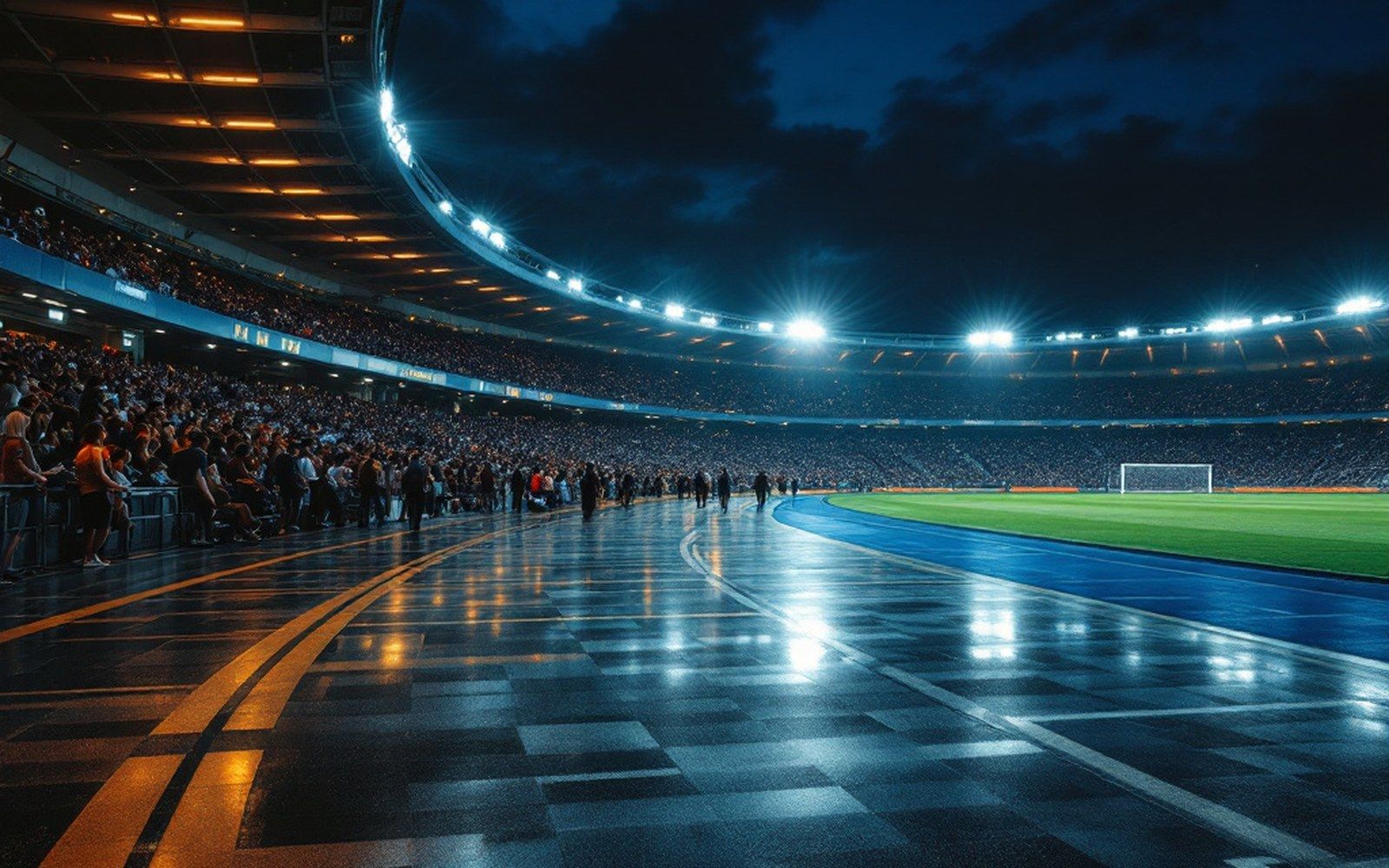
Japan had a professional league nine years old when the tournament arrived; the J.League had been built for exactly this.
Picture desk03 · NightsWhat happened on the pitch rewrote expectations
Seoul, the night the co-hosts reached the last four.
Picture deskWhatever the administrative friction, the 2002 tournament delivered the most unexpected results the competition had seen since Cameroon beat Argentina in the 1990 opening match. Senegal eliminated the defending champion France in the group stage — France arrived as holders and left without a goal — and South Korea, coached by Guus Hiddink, eliminated Spain and Germany on the way to a semi-final. It was the furthest any Asian side had gone, and it arrived in the tournament's own backyard.
Park Ji-sung, then twenty-one, was a central figure in that run, his energy and pressing range visible before the European clubs had fully understood what they were looking at. He joined PSV Eindhoven the following year, then Manchester United in 2005. The tournament had functioned as the largest possible audition for a region whose players were still largely invisible to European recruiters.
04 · NightsThe co-hosting model and what came after
FIFA drew specific lessons from 2002, most of them cautionary. The cost of dual infrastructure was enormous; the coordination burden was real; and the format — thirty-two teams across a single host ↗ — was already the maximum a single nation's transport network could reasonably absorb. The idea of co-hosting went quiet for two decades. When it returned, it returned scaled up: the 2026 tournament, expanded to forty-eight teams, is shared between the United States, Canada and Mexico — three nations and a format that would have been impossible to distribute across one.
What 2002 had proved, whatever the arguments about fairness in scheduling or the two hosts' comparative advantages, was that the tournament was portable in a way FIFA had always resisted admitting. Asia could do this. Two countries, imperfectly at peace, could jointly produce a World Cup that people still cite for its upsets, its atmosphere and the career arcs it accelerated. The structural problems were real. They were also solved.