01 · NightsMilan, and what the draw said about expectations
The 1990 World Cup had been handed to Italy on the logic that Italians understood spectacle and organisation, and for the most part that proved correct. What nobody had written into the script was the opening match. Argentina, winners in Mexico four years earlier with Diego Maradona, were drawn in Group B alongside the Soviet Union, Romania, and Cameroon — three opponents that the bookmakers and the press corps collectively filed under manageable. Cameroon, in particular, were rated at roughly nothing. They had appeared at the 1982 tournament, gone three matches without losing, and gone home anyway because they had also gone three matches without winning. In 1990 they brought a squad that averaged well over thirty years old, a coach — Valeri Nepomnyashchy, a Soviet-trained tactician — who was largely unknown outside Yaoundé, and a forward who was thirty-eight years old and named as a substitute.
The Giuseppe Meazza on 8 June 1990 held just over seventy thousand people. Argentina were the reigning world champions. Cameroon were the afternoon's footnote.
The footnote won.
Omam Biyick's header, looping over goalkeeper Nery Pumpido in the second half, was not a moment that Argentine football saw coming. It was not especially graceful. Cameroon had two players sent off — Benjamin Massing and Kana-Biyick — and still held on. Final score: 1–0. The result reverberated because it was not a close game that happened to end in an upset; it was a controlled, physical, deliberately organised performance in which Cameroon strangled the life out of the holders. Argentina created next to nothing of note. One goal. Theirs.
The result immediately reordered Group B and, for anyone watching from African football's administrations, supplied ammunition for a long-running argument about how many places CAF ↗ should actually receive at the World Cup.
02 · NightsRoger Milla, the quarter-final, and what a run like that costs the arithmetic
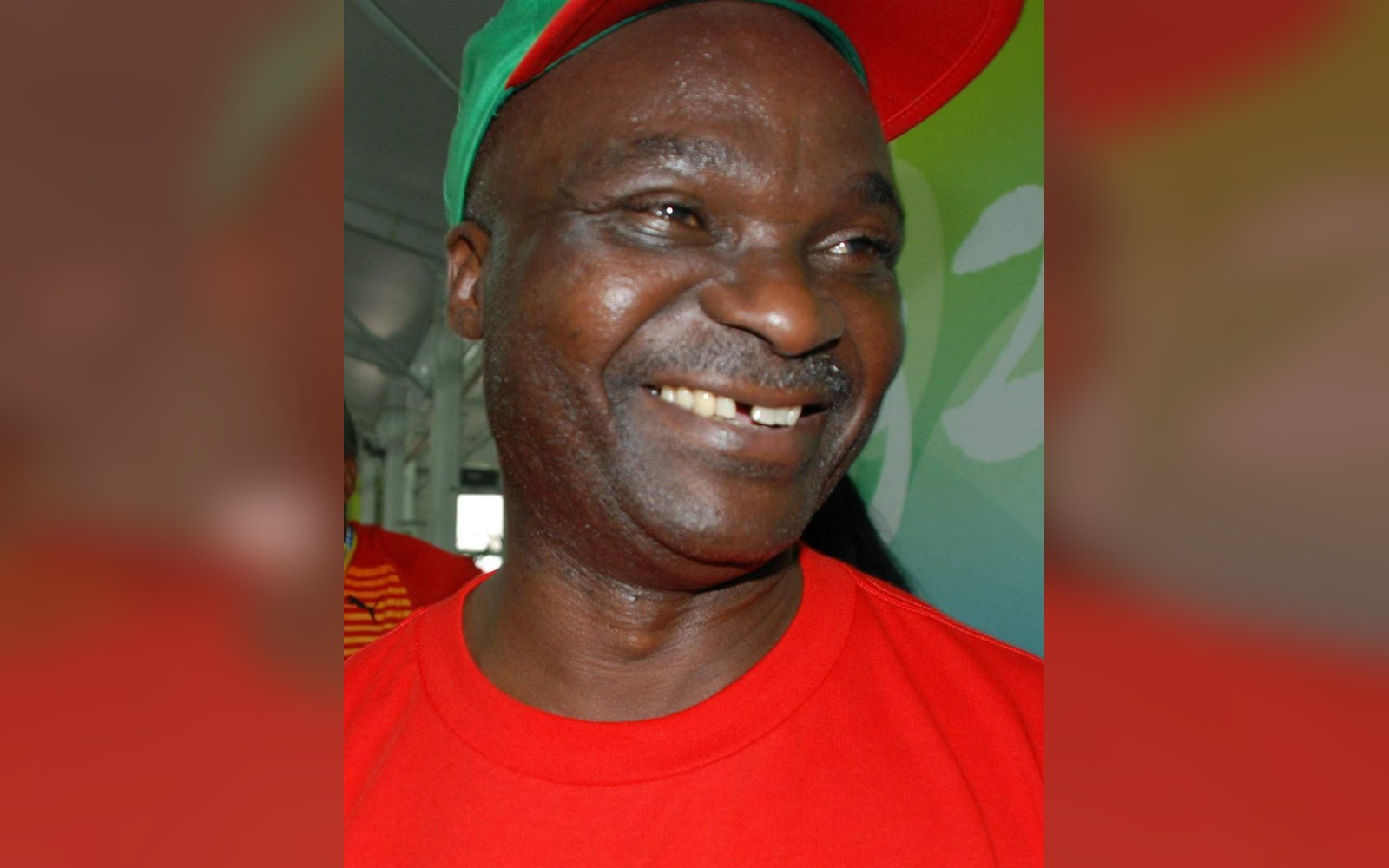
Cameroon did not stop at Argentina. They beat Romania 2–1 in their second group match, lost 4–0 to the Soviet Union, and still qualified top of their group. In the round of sixteen they met Colombia, and that is where the competition's defining image was made. Roger Milla, substituted on by Nepomnyashchy, scored twice in extra time — the second after dispossessing René Higuita far outside his area — and danced at the corner flag both times. That celebration, looping and particular, became shorthand for the tournament, and possibly for African football in a way that resisted being entirely fair to what the team had built as a collective.
What the quarter-final — and defeat there to England, 3–2 after extra time — established was a statistical fact that became politically useful. CAF had, at the 1990 tournament, been allocated two of the twenty-four places. Two places, and one of those two associations had reached the last eight. The efficiency of that return, measured against the allocations given to other confederations, was not lost on CAF's officials or on the African footballing public. The argument that followed — that the quota system shortchanged the continent — had always had a moral and a developmental dimension. After Italia '90 it had a scoreboard dimension too.
FIFA's slot distribution at the time weighted Europe and South America heavily, which reflected those confederations' historical dominance but increasingly looked like circular reasoning: Europe and South America performed well because they had more chances to perform, and those chances were justified by performance. Cameroon's run introduced a visible crack in that logic. The allocation would eventually move — CAF received three places for the 1994 tournament in the United States, then settled at five for France 1998, where it remains the baseline before the expansion to forty-eight teams changes the arithmetic again. None of those shifts happened in a vacuum, and Cameroon 1990 sits at the start of the chain.
03 · NightsWhat the team was, and what it gave African football to argue with
Two places for the whole of CAF in 1990.
Picture deskThe 1990 Cameroon squad was not a young project. Several of its key players were based in European club football — goalkeeper Thomas N'Kono had spent years at Espanyol in Spain — but the team was not the kind of polished, academically developed export product that would later come to define West African football's relationship with European leagues. It was a senior group, experienced and hard, and Nepomnyashchy organised them around defensive structure and transition. The average age was genuinely unusual for a World Cup squad; Milla at thirty-eight remains one of the oldest outfield contributors in the tournament's history. He had effectively been retired before the federation recalled him.
Milla's career before 1990 had included successful spells in France, two African Player of the Year awards, and a 1982 World Cup appearance.
That detail — veteran recalled, tournament reshaped — says something about how the sport circulates talent and how badly that circulation can be misdescribed. None of that had made him a name beyond football's more attentive corners. Two goals against Colombia, and one more against Russia four years later at the USA '94 tournament (where he became the oldest goalscorer in World Cup history at forty-two), and he became the tournament's human symbol. The danger with that is that a human symbol absorbs credit and attention that properly belongs to a structure: the defensive organisation that held Argentina to a single, disputed opportunity, the collective discipline that kept ten men together when they might easily have split.
Samuel Eto'o ↗ and the generation that followed owed something to 1990 in terms of expectation — not romantically, but practically. The tournament performance raised the credibility of Cameroonian football in European clubs' eyes and fed the scouting infrastructure that would eventually bring Eto'o to Barcelona. Didier Drogba, coming from Abidjan's football culture a few years later, grew up inside a West African football landscape that had watched 1990 and understood that reaching a World Cup quarter-final was not a miracle requiring explanation; it was a result requiring more places to repeat.
The quarter-final exit to England was painful and close. England scored first through David Platt, but Cameroon turned it round to lead 2–1. Gary Lineker equalised from the penalty spot, and in extra time he scored a second penalty to win it. It was the kind of match that, had Cameroon held on for the last minutes of normal time, would have put an African team in a World Cup semi-final for the first time — a moment that would not arrive until 2022, in Qatar, more than three decades later.
That is the lasting measure of how far Cameroon got and how alone they were in getting there. One team, two berths, the opening game, and a corner-flag dance that football has never quite put back in the drawer.