
01 · LeavingThe Factory Floor
In most of world football, an academy exists to supply the first team. You build youth infrastructure, you develop players, and the best of them walk up the corridor and into your senior squad. The model that has taken root across Côte d'Ivoire and Senegal runs on a different logic entirely. Here, the academy feeds outward. Europe is the customer; the Abidjan neighbourhood and the Dakar suburb are the supply chain.
The numbers are not incidental. Côte d'Ivoire, a country of roughly 27 million people, has consistently produced enough players to fill the squads of clubs across France, Belgium, England, Portugal and beyond simultaneously. At the peak of a generation that included Didier Drogba, Salomon Kalou, Kolo and Yaya Touré, Gervinho and Emmanuel Eboué, the Ivorian national team carried a depth of European-based talent comparable to far larger nations. Senegal has followed a similar trajectory: the 2002 squad that beat France in the opening match was drawn largely from players based in French clubs, several of whom had grown up or developed in France.
The mechanism is export. Players leave early, clubs in sending countries receive fees that are small by European standards and large by local ones, and the transaction repeats at volume. What makes West Africa distinctive is not that this happens — it happens everywhere — but that the infrastructure has been consciously shaped around it.
02 · LeavingThe Academy as Business Model
The Diambars Institute near Dakar, founded in 2003, was among the first to make the logic completely explicit. It combined formal schooling with elite football training, and its design was oriented toward producing players capable of meeting European professional standards. The model attracted international attention and international money. ASEC Mimosas in Abidjan has operated an academy — the Académie ASEC — since the early 1990s, and its alumni list reads like a map of French and Belgian professional football: the Touré brothers trained there; Cheick Tioté trained there; Emmanuel Eboué trained there. The academy's business has always been understood in terms of transfer income, because solidarity payments and training compensation flow back to the clubs that formed a player in proportion to the fees paid when he moves.
That FIFA mechanism — training compensation for players under twenty-three, solidarity payments distributed across the clubs that trained a player between the ages of twelve and twenty-three — was designed in part to prevent exactly the kind of pure extraction that critics associate with African football. The formula redistributes a percentage of transfer fees ↗ back down the chain to the academies and clubs that did the developmental work. In practice, the sums reaching West African clubs have often been contested, unpaid or difficult to recover through enforcement, which the Court of Arbitration for Sport has been asked to adjudicate in individual cases. The mechanism exists on paper; the results on the ground are uneven.
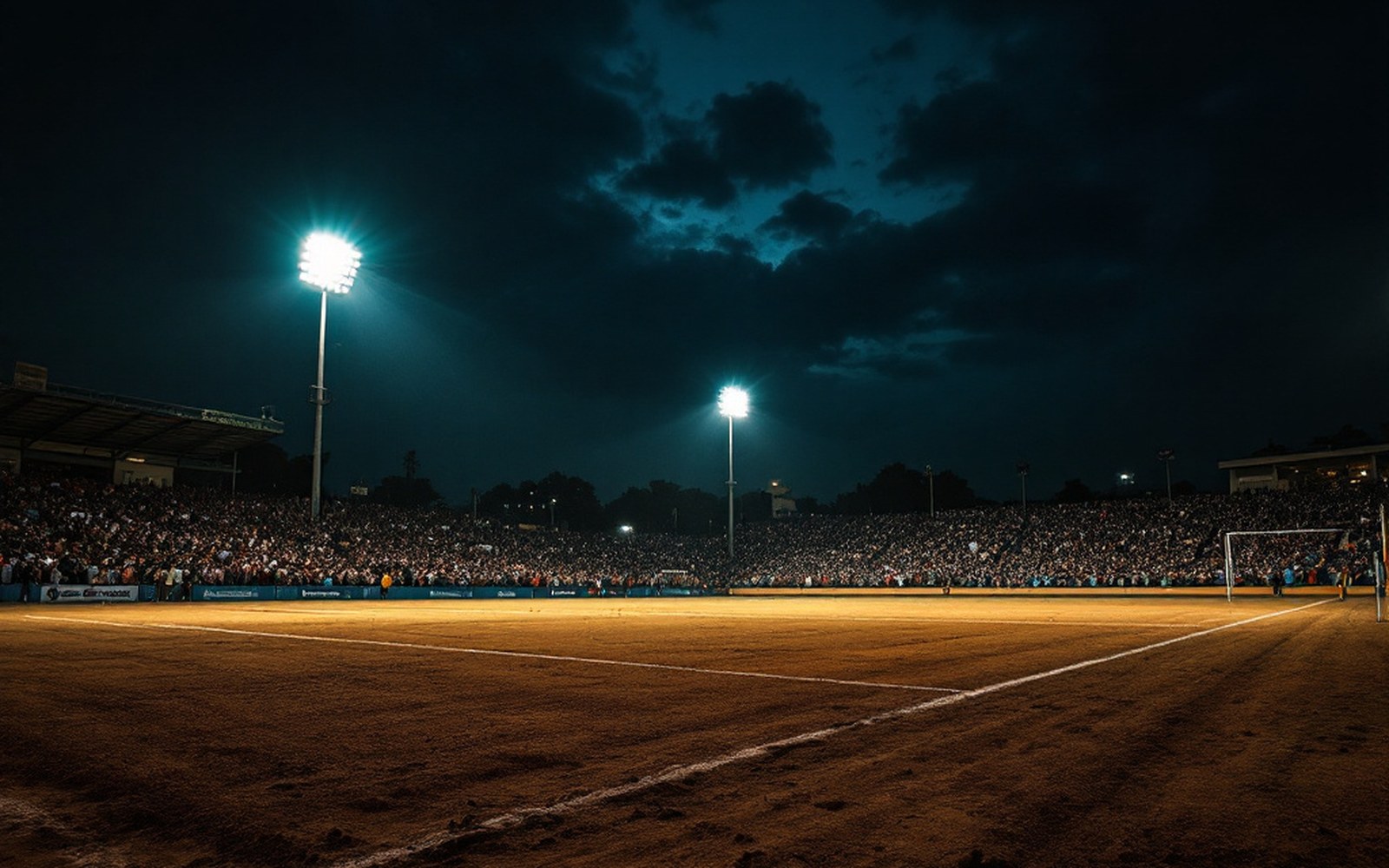
A pitch with goalposts and no nets is not the point; the point is who holds the registration when a player leaves.
Picture deskWhat ASEC and Diambars proved, though, is that an academy does not need to rely solely on those residual payments.
A club that identifies a player early, develops him under contract, and sells him directly at seventeen or eighteen controls the first, largest transfer fee rather than waiting for solidarity crumbs from a deal made six clubs later. This is the distinction between a development club that captures value and one that produces it for others. The Abidjan model, at its most successful, is the former.
03 · LeavingThe Cost of Volume

Training compensation is what the paperwork captures.
Picture deskThe scale has effects that the business model alone cannot account for. Côte d'Ivoire's domestic league, the Ligue 1 de Côte d'Ivoire, loses its best players before they reach their physical peak. The most technically refined sixteen-year-old in Abidjan is not a prize for ASEC's first team; he is an asset being prepared for a European window. The same applies in Senegal, where Ligue 1 clubs operate in the knowledge that their role in the production chain is upstream. The domestic game is watched, celebrated and genuinely supported — but it is not where careers are made or reputations cemented, and everyone in the structure knows it.
This is not a failure of ambition. It is, from the perspective of a West African club with limited television revenue and a very small transfer market to sell into locally, a rational adaptation. George Weah's career illustrated what individual escape from that structure could look like — his trajectory from Cameroon to Monaco to Paris Saint-Germain to Milan became one of football's best-known stories — but Weah was exceptional in his era partly because the infrastructure barely existed yet. The academies that came after him built the route he had to find by exceptional talent alone.
The human arithmetic is worth examining plainly. For every player who reaches a professional contract in Europe, FIFA's own data on youth transfers indicates many more are released before they settle anywhere. A teenage boy moved from Dakar to a trial in Lyon or Brussels, then released, has been educated inside a football structure calibrated for export and now sits between two systems. The Diambars model, with its schooling component, was partly designed to address this — to ensure that the player who does not make it leaves with an education rather than just an exit stamp. But not every academy operates with that consideration.
04 · LeavingWhat Stays, What Leaves
When Didier Drogba built a football academy in Abidjan after his playing career — the Didier Drogba Foundation has invested in educational and sporting infrastructure in Côte d'Ivoire — it was partly an acknowledgement that the export pipeline had not necessarily reinvested in the city that made him. The gesture was private and charitable rather than structural. The structural question — whether the fees leaving for Europe return to the streets of Treichville or the suburbs of Dakar in any meaningful form — does not have an easy answer, because the flows are opaque and the domestic leagues are not well capitalised enough to trap capital locally.
What is not in doubt is the quality of what is produced. The generation of Ivorian players who peaked between roughly 2005 and 2015 was, by any competitive measure, one of the finest a single African country has assembled. The Senegalese generation that followed — built around players like Sadio Mané, who came through Senegal's Génération Foot academy before moving to Europe, — carried West Africa to the top of the African continental rankings. Morocco's 2022 semi-final run drew enormous attention as an African breakthrough, but Côte d'Ivoire and Senegal had been producing players capable of competing at that level for twenty years. The difference was where those players were competing: not in a national team deep run, but in the Champions League, the Premier League and the Bundesliga, wearing other colours.
The Abidjan academy and the Dakar training ground did not fail to keep their talent. They built their entire model on not keeping it. That distinction — between failure and design — is the thing most commentary on African football misses.